When to Hire an Attorney for a Vermont Workers Compensation Claim
By Law Office of Aili Obandja
If you were hurt at work in Vermont, you may be wondering whether you need an attorney or whether you can handle the workers’ compensation process on your own. The answer depends on what is happening in your claim. Some claims are accepted and paid without major disputes. Others become complicated quickly, especially when benefits are delayed, medical treatment is denied, or the insurance carrier questions whether the injury is work-related.
This article explains common points in a Vermont workers’ compensation claim when it may be time to speak with an attorney.
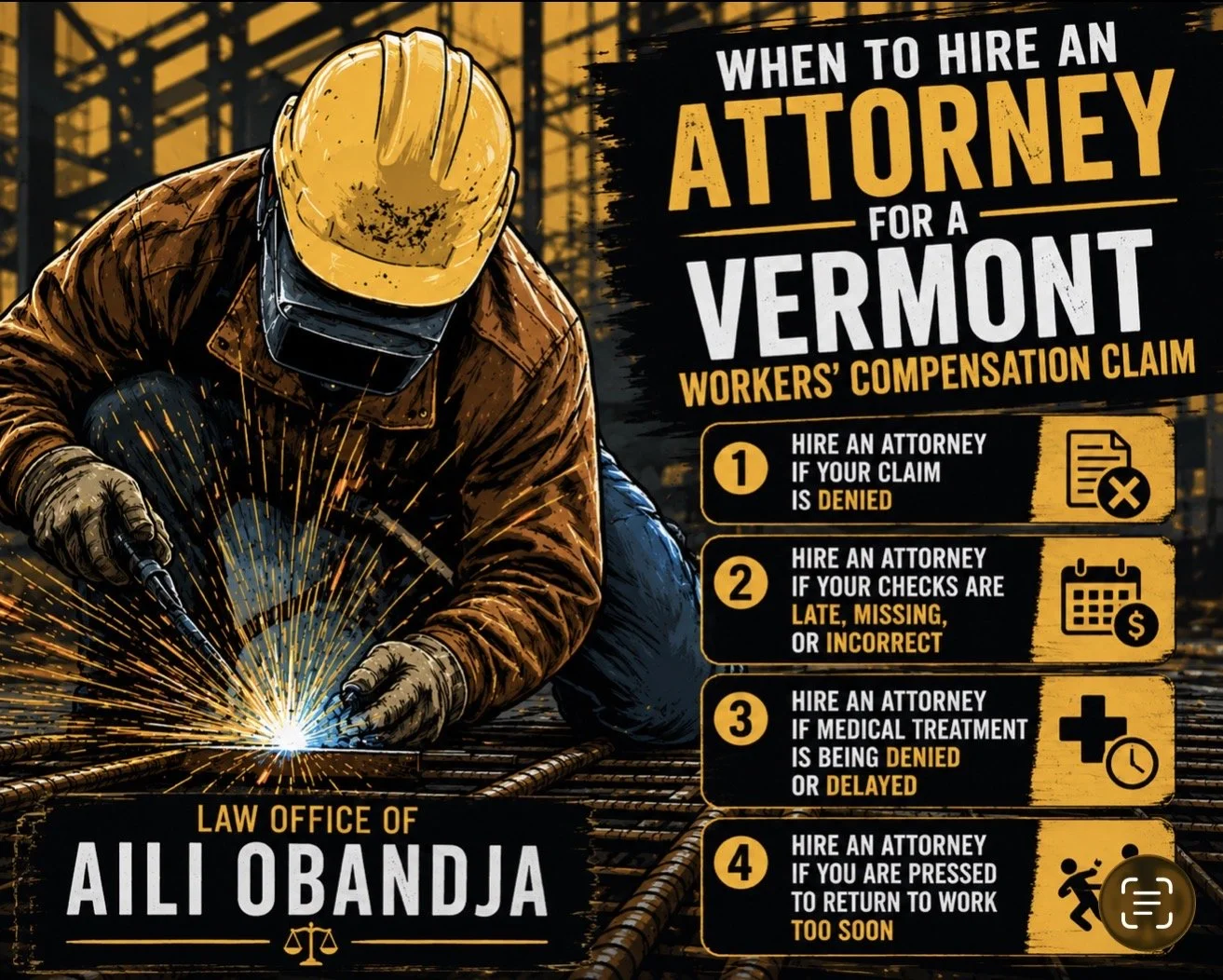
1. Hire an Attorney if Your Claim Is Denied
One of the clearest signs that you should contact an attorney is receiving a denial of workers’ compensation benefits. In Vermont, a denial may involve the entire claim, lost wage benefits, medical benefits, or a specific medical bill or treatment request. The Vermont Department of Labor’s Form 2, Denial of Workers’ Compensation Benefits, requires the employer or insurance carrier to identify the type of denial and provide the basis for it. Vermont Department of Labor, Form 2 – Denial of Workers’ Compensation Benefits
A denial does not always mean the claim is over. It means the carrier has taken a position against paying some or all benefits. An attorney can review the stated reason for denial, compare it with the medical records and facts of the injury, and help determine whether the denial should be challenged.
Common denial issues include:
The carrier claims the injury did not happen at work.
The carrier says the medical condition is preexisting.
The carrier agrees there was an injury but disputes the need for treatment.
The carrier refuses to pay wage benefits.
The carrier disputes whether the worker is disabled from working.
If you receive a denial, it is usually better to seek legal advice promptly rather than waiting until deadlines, evidence, or medical documentation become harder to manage.
2. Hire an Attorney if Your Checks Are Late, Missing, or Incorrect
Workers’ compensation benefits can be critical when an injury keeps you out of work. If wage replacement checks are late, missing, reduced, or calculated incorrectly, the problem should be addressed quickly. Vermont’s workers’ compensation system includes procedures for disputed or miscalculated benefits, and the Department’s rules recognize that an injured worker may challenge a denial, discontinuance, or miscalculation of benefits. Vermont Department of Labor, Workers’ Compensation and Occupational Disease Rules
An attorney can help determine whether the carrier is using the correct wage information, whether the correct benefit type is being paid, and whether the carrier has followed the required process before stopping or reducing benefits.
3. Hire an Attorney if Medical Treatment Is Being Denied or Delayed
Medical treatment is often the center of a workers’ compensation claim. Problems can arise when the carrier refuses to authorize treatment, delays approval, disputes a referral, questions the treating doctor’s opinion, or sends the worker for an independent medical examination.
You should consider speaking with an attorney if:
Surgery, injections, therapy, imaging, or specialist care is denied.
The carrier says treatment is not related to the work injury.
The carrier says treatment is not reasonable or necessary.
Medical bills are unpaid or sent to collections.
A doctor releases you to work before you believe you can safely return.
These disputes can affect both your health and your benefits. An attorney can help organize the medical evidence, communicate with the carrier, and determine whether the dispute should be brought before the Vermont Department of Labor.
4. Hire an Attorney if You Are Pressured to Return to Work Too Soon
Returning to work after an injury can be positive when it is medically appropriate. But it can also create serious issues if the job duties exceed your restrictions or if the employer offers light duty that does not match what your doctor has allowed.
You should seek legal guidance if:
You are told to return despite ongoing restrictions.
The employer offers work that seems outside your medical limits.
You are threatened with termination for not returning.
Your benefits are stopped because the carrier says you can work.
Your doctor and the carrier’s examiner disagree about your work capacity.
A lawyer can help evaluate whether the return-to-work offer is appropriate and whether any reduction or termination of benefits is proper.
5. Hire an Attorney if a Hearing May Be Needed
When a Vermont workers’ compensation claim is contested, a party may file a Notice and Application for Hearing, commonly known as Form 6. The hearing process is more formal than ordinary claim communications. It may involve evidence, medical records, witness testimony, legal arguments, and deadlines. Vermont Department of Labor, Workers’ Compensation and Occupational Disease Rules
If your claim has reached the point where a hearing may be necessary, it is wise to speak with an attorney. A lawyer can help identify the disputed issues, gather supporting evidence, prepare the claim, and present your position clearly.
6. Hire an Attorney Before Agreeing to a Settlement
Settlement can provide closure, but it can also affect your future rights. Before signing any settlement agreement, you should understand what benefits you may be giving up, including future wage benefits, medical benefits, permanency benefits, or the right to reopen certain issues.
An attorney can help evaluate whether a proposed settlement accounts for:
Unpaid wage benefits;
Future medical treatment;
Permanent impairment;
Work restrictions;
Vocational limitations;
Medicare or other benefit issues; and
The risk of future disputes.
In Vermont, workers’ compensation settlements generally must be submitted through the Department’s settlement process and may require Department approval. That makes it especially important to understand whether the agreement resolves only part of the claim or closes the claim more broadly. It is also especially important to get advice if the carrier presents a full and final settlement or asks you to close out future medical rights.
7. Hire an Attorney if You May Have a Permanent Impairment
Some work injuries leave lasting impairment even after medical treatment ends. If your doctor places you at medical end result or maximum medical improvement, there may be questions about permanency benefits, impairment ratings, work capacity, and future medical care.
An attorney can help determine whether the impairment rating is supported by the medical evidence and whether additional medical evaluation is appropriate.
8. Hire an Attorney if Someone Other Than Your Employer Caused the Injury
Some workplace injuries involve a third party, such as a negligent driver, property owner, subcontractor, manufacturer, or another company. In those cases, the injured worker may have both a workers’ compensation claim and a separate third-party claim.
These cases can involve liens, reimbursement rights, settlement allocation, and coordination between claims. An attorney can help protect the workers’ compensation claim while also evaluating whether a separate claim should be pursued.
When You May Not Need an Attorney Right Away
Not every workers’ compensation claim requires immediate legal representation. If the claim is accepted, benefits are being paid correctly, medical treatment is approved, and you are recovering without dispute, you may be able to proceed without an attorney at the early stage.
Even then, it can still be helpful to speak with a lawyer if you are unsure about your rights, if your injury is serious, or if the claim begins to change. Many problems are easier to address before benefits are stopped or evidence becomes stale.
What to Bring When You Speak With an Attorney
If you contact an attorney about a Vermont workers’ compensation claim, try to gather:
The date and description of the work injury;
Any written injury report;
The First Report of Injury, if you have it;
Any denial, discontinuance, or benefit notice;
Recent pay stubs or wage records;
Medical records and work notes;
Names of witnesses;
Any letters or emails from the insurance adjuster; and
Any settlement paperwork you have been asked to sign.
The Vermont Department of Labor also provides an employee claim form, Form 5, for an injured worker’s notice of injury and claim for compensation. Vermont Department of Labor materials indicate that if an employer fails to file the First Report of Injury, the injured worker may file Form 5 with the Department, generally within six months of the date of injury. Vermont Department of Labor, Form 5 – Employee’s Notice of Injury and Claim for Compensation
Bottom Line
You should consider hiring an attorney for a Vermont workers’ compensation claim when the claim is denied, benefits are delayed or stopped, medical treatment is disputed, the carrier pressures you to return to work, a hearing is needed, or a settlement is proposed.
The earlier you understand your rights, the better positioned you are to protect your health, income, and future benefits.
If you have questions about a Vermont workers’ compensation claim, the Law Office of Aili Obandja can review the facts of your situation and help you understand your options.
Disclaimer
This article is for general informational purposes only and is not legal advice. Reading this article does not create an attorney-client relationship. Every claim depends on its specific facts, medical records, and procedural history. If you need advice about your own situation, you should consult an attorney about your particular claim.
