A Stamp of History: Celebrating Harriet Powers this Juneteenth
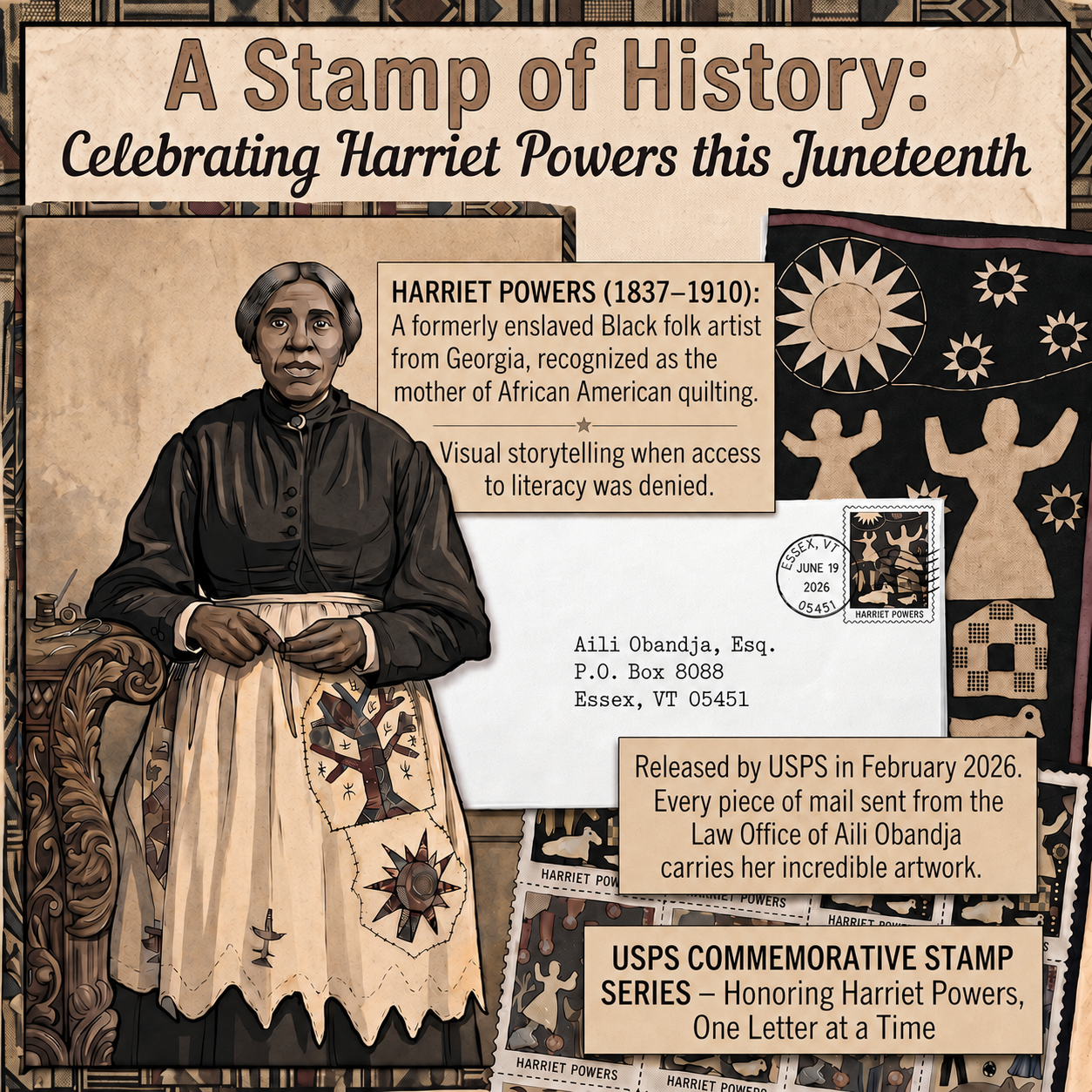
As a solo practitioner, some parts of running a law firm are more enjoyable than others. One task I look forward to is visiting my local post office to buy stamps!
I run a low-overhead firm, which means everything I do is highly intentional—from the clients I choose to represent right down to the envelopes I mail out.
I've always appreciated art and history, so I try to choose stamps that reflect both. In the past, I've purchased stamps featuring artists like Keith Haring and cultural icons such as Muhammad Ali.
Back in March, I stopped by my local post office to replenish my stamp supply. I was disappointed to learn that my usual favorites were out. But to my delight, my local postal worker, Michael, pointed out newly released stamps honoring Harriet Powers. I immediately purchased them.
Since March 2026, every piece of mail sent from the Law Office of Aili Obandja has carried a stamp featuring her incredible artwork.
That choice was intentional.
Harriet Powers (1837–1910) was a formerly enslaved Black folk artist and quilter from Georgia who is widely recognized as the mother of African American quilting. Born into slavery, she belonged to the generation of Black Americans who experienced emancipation and the difficult transition from slavery to freedom following the Civil War.
Powers blended West African appliqué techniques with biblical narratives, local history, astronomical events, and scenes of daily life. Her quilts served as visual storytelling at a time when many African Americans were denied access to literacy and formal historical records. Through her craft, she preserved stories, faith, and cultural traditions, creating a lasting visual archive of African American life and history.
For much of the twentieth century, Harriet Powers' contributions were overlooked by the art world. Today, she is recognized as one of the most important American folk artists of the nineteenth century.
Although Powers created numerous works, only two of her quilts are known to survive today. Her Bible Quilt (1885-1886) is preserved at the Smithsonian National Museum of American History, and as noted by the Museum of Fine Arts in Boston, her Pictorial Quilt (1895–1898) remains safely displayed in their collection.
In February 2026, the United States Postal Service honored her legacy with a commemorative stamp series featuring imagery from her celebrated Pictorial Quilt.
As we approach Juneteenth next week, Harriet Powers' story feels especially meaningful. Juneteenth commemorates June 19, 1865, when enslaved African Americans in Texas finally learned of their freedom more than two years after the Emancipation Proclamation. It is a day to reflect on the enduring struggle for freedom, celebrate Black culture and achievement, and honor those who preserved African American history despite extraordinary obstacles.
Both Juneteenth and Harriet Powers represent resilience, cultural preservation, and hope. While Juneteenth marks the realization of freedom, Harriet Powers' quilts remind us that preserving stories, traditions, and community is itself an act of resistance.
I am proud to share a small piece of Harriet Powers' legacy on every letter that leaves my desk. Her quilts preserved stories that might otherwise have been lost, reminding us that history is often carried forward through everyday acts of creativity, resilience, and remembrance.
Sometimes even a postage stamp can tell a powerful story. ✉️✨
By: Aili Obandja, Esq.